Get ready to approach your finances with confidence and ease! In this episode of The Organized Coach Podcast, Tracy Hoth interviews Shana and Vanessa, the “Budget Besties,” who have turned their friendship into a mission to redefine personal finance. They share all their practical strategies that can transform your thoughts about money.
They also share their journey from best friends to business partners and introduce their innovative digital budget system (one of my favorite words!), modernizing the traditional envelope system. The conversation covers their passion for helping women organize their finances, manage money with intention, and achieve financial goals through automation and strategic planning.
Shana and Vanessa highlight the importance of creating a practical, customizable budget system. They discuss how to automate (another favorite word of mine) finances for simplicity and how to use tools like bank apps to stay consistent.
If you are ready to prioritize money, join their Money Makeover Bootcamp, which will run from December 30th to January 3rd. The boot camp is designed to help you gain clarity, confidence, and control over your financial future.
The key moments in this episode are:
02:54 The Journey to Financial Coaching
03:47 Podcast Success and Strategies
08:17 Creating a Budget System
15:12 Automating Your Finances
19:05 Utilizing Your Bank App for Budgeting
19:28 Automating Your Finances
28:28 Empowerment Through Financial Awareness
30:26 Monthly Budget Meetings
Your Bringing-You-The-Experts Coach,

Connect with Shana And Vanessa:
Shana & Vanessa are best friends and business partners on a mission to redefine personal finance for women worldwide. They’re keynote speakers, master financial coaches, and co-hosts of the top 1% globally ranked podcast, Financial Coaching For Women. As some of the only people who truly love talking about budgets, Shana and Vanessa know how to make personal finance fun, judgment-free, and refreshingly simple. They help people who make good money but have nothing to show for it set up a budget tailored to their lifestyle and goals.
As moms, wives, best friends, and business partners, they bring a unique blend of real-life stories, practical advice, and humor to every conversation. Together, they’ve built a thriving, multiple six-figure business completely debt-free. Bringing over a decade of coaching experience to the table and training by Dave Ramsey, Shana and Vanessa are removing the shame from money talk and teaching women worldwide how to take ownership of their finances.
➡️ Click here to join their Money Makeover Bootcamp!
Budget Besties Website
Instagram
Facebook
Listen to their podcast Financial Coaching for Women
Resources Mentioned:
💥 FREE Workshop: 3 Simple Steps to an Organized (and Profitable) Business – where I share the only 5 files you need to organize your digital files.
👉🏼 Organized Coach Academy
Idea Tracker
Client Tracker
FREE File Naming Formula Cheatsheet
Connect with me:
Subscribe and Listen:
If you love what you’re learning on this podcast every week – the strategies, how-tos, and time-saving ideas to set up your organized and systemized business so you can work less and scale – please follow, rate, and review by heading to Apple Podcasts or wherever you listen to podcasts.
Transcript with time stamps:
[00:00:00] Tracy Hoth: Knowing your numbers gives you the power to actually do something. Money awareness, an asset tracker. Today we’re going to talk to two best friends that started a business together and why are they so dang excited about budgeting? Does a pretty budget make you more apt to budget than to check in and to keep going?
And then the big one, how do you automate it all? They share their system for money. How you can create a system for money, not the old envelope system. This is all online, digital. They have a money makeover bootcamp coming up December 30th. You’ll hear about that. And the links to join that are in the show notes.
From a business perspective, they have a podcast and they put out three episodes a week. They kind of share their framework for what their week looks like and how they do it. working together and with family. That’s really interesting to hear. Let’s get into this week’s episode with Shaina and Vanessa, best friends on a mission to redefine personal finance for women worldwide.
They host the Globally Ranked Podcast, Financial Coaching for Women, and they are excited and passionate about helping you be more intentional, automate and systemize managing your money. Are you ready to work less? Feel more organized and productive, streamline repetitive tasks, and implement systems that allow your coaching business to run smoothly, even without you.
If so, you’re in the right place. Welcome to the Organized Coach Podcast, your go-to source for practical tips and solutions. I’m your host, Tracy Hoth, professional organizer, certified life coach, simplifying expert, and most of all, down-to-earth fellow coach, just like you. No matter if you think you’re missing the organizing gene, have ADHD, or just love anything organizing, I’m here to help you become an organized coach with a business that works for you.
Pull up a seat and let’s get started. I’m so excited about this interview. We’re going to talk about finances and budgeting and all of that. But let me just have the two of you, my special guests, introduce themselves first. Welcome.
[00:02:19] Shana: Thank you1 We are happy to be here. We’re going to talk about the B word.
If everybody already turned it off because you said finances and budgeting, don’t worry. We’re going to try to make it fun and we’re going to take the shame out of it. It’s not going to be, it’s going to be, it’s going to be okay. Just stick with us. Yes.
[00:02:33] Vanessa: I’m Vanessa and I’m Shana and we are best friends and business partners.
We are the budget besties. We’ve been in business for five years and figuring this thing out together. We love what we do. We love who we work with. We love the relationships that we build as we meet new people. It’s been, it’s been really fun.
[00:02:52] Tracy Hoth: Okay, so tell me more about that.
How do best friends? Were you best friends before your business partners? You guys are just talking and you’re like, Hey, let’s start a business.
[00:03:03] Shana: Not exactly. We have been friends. We met when our boys were four and they’re now 16 – everybody pause and do the math there. So we’re down. Yeah, we’re down.
We’re fine. We’ve been friends for a long time and both of us had a very special financial journey. Put it that way. Yeah. And we’re both nerds. Like, let’s just be honest. We love, we love doing math. It kind of led us to doing this business. We ran across each other, met each other in a podcast growth program.
[00:03:40] Tracy Hoth: You guys were just so amazing. You shot to the top and you had a lot of wins, I guess I would say. You were like our shining example. Tell me just first two about that, because I have a lot of people that have podcasts that listen, and I want to hear how you guys decided to do that.
Also how you became, cause you’re always in the top rankings. And so how did that happen?
[00:04:02] Vanessa: Well, when back, it was like a year and a half ago, almost two years ago, I guess you could say now, gosh, I can’t believe it’s been that long, but we were at a point in our business where we’re like, we’re doing something wrong.
Something isn’t right. We’re missing a piece of the puzzle. Right. And so when we found her program, it was basically like, take all of our money. However, Vanessa is very, I don’t want to say frugal, but I’m very like, Oh my gosh, if we’re going to spend this money, we have to do it right. Like if we’re going to go all in and do this, we have to do everything that she says.
Be the best student, be coached by her as much as we could.
[00:03:03] Shana: It’s Stephanie Gass, if anyone’s listening and wants to know. I took her podcast Pro University. Did you guys do that? You already had a podcast.
[00:05:02] Vanessa: We bought it when we bundled it, yeah, when we bought the P2P program. And so we like did that really quick and then moved on to P2P.
[00:05:10] Tracy Hoth: Do you do two podcasts a week? Did you start there? Did you do three?
[00:05:15] Shana: Okay. Together, we are extra. One thing that we like to highlight how extra we are is when we became friends, We first became friends, we went to church that weekend, basically. Two weeks later, we were leading a community group with a brand new church that we were going to.
We like, that’s the intensity level that we’re at. Right. So when we, Vanessa was talking about, we, we wanted to be the best students, but we also had wasted money on other coaching and we were trying to figure out what was the business that was going to finally take off. And so we niche, we, we dwindled, we dwindled down to one thing, which is specifically financial coaching.
Then we listened to our friend, Alex Ramosi. He’s very close, personal friend. Not really. And basically he says, if you’re going to do it, you might as well do it all the way. And we said, Oh, what? One episode is not enough. Let’s go for three. Why not? Um, not maybe not realizing how much more work that was going to be.
It’s fine. So we do put out three episodes a week. We never run out of content because we coach, we coach our clients and it’s just never ending, you know, it’s never ending. So, and it allows us that part of the business that we get to do together. Like we are here with you today. A lot of the time coaching we’re separate.
We love it.
[00:06:21] Vanessa: Yeah, it is a lot of fun and, and when we heard Alex say, he was talking about a conversation that he had with a coach and he said, well, why am I not growing on Instagram or social media? It was the, whatever plat, whatever platform he was discussing with his coach. And he said, well, I’m doing 10.
You have one post. Yeah. He’s like, I’m doing 10 posts a day. Alex, you’re doing one. And he was like, oh, you know, so it was that idea of 10 Xing, whatever you’re doing. And so that version for us was Instead of doing one episode every now and then when we felt like it or when we had time. That’s not a good strategy.
[00:06:48] Shana: Right.
[00:06:49] Vanessa: Honestly, we actually recorded like this little mini series of like our, our systems and we released it. I think Shane had released it all in one week and we exploded from that and we were like, Oh, there’s something to this being consistent. Then when we joined P2P and we made the decision to do three a week.
That really helped us propel.
[00:07:10] Tracy Hoth: Are you still doing three a week? I didn’t look at the dates. Oh my gosh, how are you doing that? So you must be incredible, um, money managers and time managers.
[00:07:21] Vanessa: Well, our time is very important to us because we are like Monday is CEO day and really just kind of figuring out what’s going on for the week.
Tuesday, Wednesday, we coach our one on one clients. So like she said, we’re not together those days. We try to take Thursdays off because we had two full days of coaching. So we try to. debriefing on Thursdays and then Fridays are our strategic podcasting days. Now, doesn’t always work out that way. Uh, we try to keep within those, that time frame as much as we can.
But like Shayna said, we coach our clients that we have so much, so many, so many conversations and so much topics and, and even our clients sometimes in the sessions are like, Hey, you should do a podcast on this. And we’re like, Oh, you’re right. You know, so we just, we constantly have content.
[00:08:01] Shana: Yeah. Yep. We really do.
I was looking at my messages that I just sent her yesterday. Yesterday, and I, I had so many, just so many episodes that we needed to do based on what was happening through the day. And so that, yeah, so that’s, that’s how that works. We, you know, when it comes to investing, we think it’s really important to invest in yourself and in your education for personal business, whichever.
But like Vanessa said, we always want to be the best steward of that. And so, so we, we did as much as we could with that. And it reminds me of when I bought jogging stroller. This is way back when, before we were, we’re now bougie on a budget, Tracy, but before we were frugal, we were a frugal friend and I bought a used jogging stroller when my baby, when I was gonna have my third baby.
It was like 300 and I was really like, Oh, and so much money. So what I did is I used it so many times every single day because I was like, if I’m spending this money, I have to, I have to make sure I get every penny’s worth out of it. And so that’s kind of where we’re at, where, you know, what we teach now, we want, we want people to understand that budgets aren’t a bad thing.
It can give you the permission to spend, freedom to spend. You can be bougie on a budget. You can, you know, the program that we all paid for, it was in our budget, but we just want to be, we want it to align with our values and we want to be good stewards. Yeah.
[00:09:19] Tracy Hoth: I love that. Okay. Let’s talk money. Okay, do you guys have a money story that brought you to this point or you just always were into money? Or you just wanted all people?
[00:09:31] Vanessa: Well, I think we were both financially wired, like, and like she said at the beginning, we both had our, our own journey on how we kind of came, got to this point. But honestly, it was completely led by God. Like he paved the way and really brought us together. She was in Virginia.
I was in Florida. She was moving back. It was just like, uh, you know, we were. Really needed a sign like neon shining light sign is shine sign from God going. What am I supposed to be doing next? What is the next right step and it was it was this
[00:09:59] Shana: You know, honestly People, you know, you’re your audience’s coaches and there’s a lot of hurt.
There’s a lot of healing that needs to happen a lot of Education and, and, you know, just improving yourself. What we found, so we’re Dave Nersey, Dave Nersey. Wow. Dave Ramsey nerds. Okay. What we found when we were teaching his, his church course is financial peace university is people were hurting. They didn’t understand how to budget.
They like, he teaches them to get out of debt and do this other stuff. People don’t know how to budget. It was such an, such a need. That we just really were like, let’s go all in on this. This, this is, this is a gap maybe in the market. And, and so not only do we love it and we’re nerds and we could stay in spreadsheets, I mean, we make a new spreadsheet every week.
Let’s be honest. We love spreadsheets, but we wanted to really take that pain away from people that, and, and, you know, along with what you teach, help people organize their money, everything that we teach is about organizing your money and getting it on a system that’s automated.
[00:10:58] Vanessa: Well, and people thought it was one way or another way, like you can pay off debt or you can live.
You can go on vacation or you can pay off debt. And so what we found, especially when we taught FPU was like Shana said, we actually added an extra day into the FPU lesson for budgeting because we realized that people are coming to, you know, the very first session was make a budget. And then we would move on to the next topic.
They were like, but I don’t know what I’m doing weeks to make this budget. What does it look like? And after I make it, what do I do with it? And so we actually sat down with them and made their budget. And like Shannon said, it was a completely missed opportunity, a complete missed opportunity, excuse me.
We really figured out that they need help. They need to know how to properly organize, systemize, and manage their everyday money. And from that, that’s when you can be successful with your long term goals and that vision that you have on going vacation and paying off debt and being prepared for Christmas and annual bills and things like that that come up that people don’t really know how to budget for.
[00:12:01] Tracy Hoth: Yeah, so tell me more with that. When people, when you’re saying that, I’m like, ooh. What do people think of is budgeting, and why is it so hard for them to make a budget? And then what do you teach to make it easier, I guess? Or you just do it with them? Okay.
[00:12:20] Shana: There’s a lot of questions in there. Hold on, Tracy.
[00:12:23] Vanessa: One at a time.
[00:12:24] Shana: Okay. A budget is just telling your money where to go instead of wondering where it went. That, that’s really, usually we’re just spending and we’re like, or we’re using that credit card limit and we’re like, well, hopefully it’s going to all work out. Yeah. But instead, what we’re going to do is put the money, uh, put your money on paper on purpose, right?
Which can, again, this is, can be fun. First of all, we have a budget system. You can check it out. It’s pretty okay. It’s actually fun to look at. Okay. It’s not, it’s not boring nerd dude stuff. Yeah. But what we want you to do is get on a budget, get organized and it’s, it’s, it can be fun. It can be what’s going to fund your vacations.
Like Vanessa said, or if you want to go get your nails or your hair done, like it doesn’t, it’s not this restrictive I can’t think it’s I’m giving myself permission to save for the things that are exciting to spend money on what’s important to me and to make sure my bills are paid.
[00:13:09] Vanessa: What we think is when you’re looking for a budget or you’ve tried to budget in the past, probably the reason why that haven’t hasn’t worked before is because, um, there was no system attached to it.
It’s not necessarily the budget that’s not working. It’s that you have a budget, you have a bunch of words and numbers on paper, and then you don’t know what to do from that because there’s no, there’s nothing telling you what to do with that information. And so what we’ve come up with and what has evolved over our coaching in the last five years is that we actually have developed a budget system.
We went, when we first started doing this, like we wanted to use a budget. Maybe partner with somebody that already had, you know, we go on Etsy, there’s a bunch of different budgets out there that we looked at and trying to partner with somebody to use for our business because they’ve already done that hard work.
We did not find one that we liked that had, that wasn’t simple, that wasn’t pretty, that wasn’t organized. Actually, we hired a designer. Somebody that was an expert in that field and we created our very own system, our own budget with our own flow and how to, and to show you how to do it and in the most simple organized way possible and our people love it.
[00:14:17] Tracy Hoth: Ooh, that makes me want to go get it. Okay. Cause when I think of budgeting, I think envelope system, you know, cause I love Dave Ramsey and listening to him and like pulling money out and it’s just so complicated and really in, in my mind. We, I mean, we lived tight for many, many years. Now it’s loosened up a little bit, but we, I just think if I don’t have money in this one thing, like gas, it’s not like I’m not going to fill my car up with gas.
I’m just going to pull it from another category and then pretty soon the categories didn’t even matter. So that’s my, that’s my thought about budgeting. I love it. So yeah. It’s so true. Speak to that.
[00:14:58] Shana: Yeah. You, you’re robbing Peter to pay Paul is what Vanessa would say. So that’s why we want you, you know, to, to put this on paper and we’ve taken the cash envelope system basically and made it digital and we’ve, we’ve made it automatic.
Just real quick, when, when, what we’re, what our system really is about is. You have your income. Okay. This is a great number. We’re really excited. It’s the positive number in your budget. So we’re going to take your income. We’re going to subtract any debt minimum payments that you have. That’s the first part of the budget.
Those are not fun, but we got to get, we got to get those paid. And then we’re going to take and list out all your bills. So your budget is only going to have five categories. So let’s get, let’s get excited. It’s not a big deal. I can do this in like, and it’s on one page. I can do this in like a couple minutes.
It’s fine. Okay. So then you’re going to list all your bills, which we can get. We’re going to come back to that. Remind me. We’re going to circle back to your bills. And then you’re going to list out your spending. So when you’re saying, in a month, what do I spend on gas? In a month, what do I spend on groceries?
In a month, what do I spend on my hair? What do I want to do for personal money? You know, whatever you’re spending when you’re going to the store and swiping, we’re going to put that there. And then if we have any savings that we need to do, people generally say, I need to save money. That’s not a, that’s not a, that’s on what you’re saving for vacation.
You’re saving for a, a new water heater, whatever. So we’re going to put that in the budget on purpose. And so what happens is the income comes in the bills account and you’ve created, or you’ve decided how much needs to stay in that bills account. Okay. Okay. Okay. And it does, and it pays all the bills automatically.
You don’t have to do anything automatic transfers, then go to your spending and your savings accounts based on what you put so that you always have money for whatever, when you’re at the gas tank, there is money in that account, the right amount, because you set, you set it up correctly, um, in that account so that you can just get gas.
Or when you’re at Starbucks, you’ll have your spending account where you can go pay, uh, go pay for your coffee. And you always know where the money that you need for that moment is coming from. And you always have it.
[00:16:51] Vanessa: The problem is, is that people are still banking like they did when they were 18, right?
You remember going to the bank with your mom, maybe you opened up one checking account, one savings account, and you called it a day and you went home, and then that’s how you’ve continued to bank now that even when you’re 45. But what we’re teaching is to open up a couple more accounts. Like, think about, like Chana said, we’re, we have, This paper, or this envelope system, this cash envelope system that maybe you did in the past, or your parents did, or your grandparents, you watched that evolve, or you heard people talk about it online.
Well, let’s, what is the digital version of that? How do you have a couple of different accounts and organize your money that way so you can strategically see quickly on your bank app what money is for what? So when we’re talking about having these accounts, like Shannon said, you’re going to have one main account that you’re going to deposit all your money into and you’re going to pay all your bills out of.
That’s it. That’s the only thing that’s all that account does is pay all your bills. You only leave enough in there to pay your bills. Then, you get to transfer money into a separate spending account. And that spending account is what, if you decide that on your budget, okay, you’re the one that puts the limit or however much you want to spend in a month, you, you transfer a certain amount of money in there, every paycheck.
Every single paycheck, you have a certain amount of money going to that spending account and it allows you to spend freely within guardrails, right? So, and it’s not, you don’t have to track anything either. So the only thing you have to look up is how much money I have in that spending account And that’s it.
It takes all this like accounting and tracking and people think that they have the guesswork out of it. They think they have to use an extra app to track like how much they spent here and there and where and like, no, like there’s no guesswork on when you go to the store going, Hey, is that bill already paid?
Is that the water bill come out? When is this coming out? When? So it’s the money in the account. Is that how much I actually have to spend? No, we’re literally taking. Okay. Okay. And transferring the amount of money that you can spend out into a separate spending account, and that’s the only thing you have to look at.
[00:18:49] Tracy Hoth: Amazing. When you say automation, like, what does that mean? Is it hooked to your bank account, and it shows it all, it does it all? Or how does that work?
[00:18:57] Shana: That’s why we always say you don’t need another budget. You need a budget system. And like Vanessa alluded to, people think they need this app or they need this other thing.
You just need your own bank app because they, we are in a digital age. There are tools, girl that can help you. Right? So, so your bank app, you can, there’s so many things that can do, it can, you can rename accounts. You, first of all, obviously, like Vanessa said, you’re gonna have to open more than one account.
Okay? Then you can rename them and put them in the order, like, maybe I don’t want to see my good savings book at first. I want to see my spending and my bills, right? You can auto, you can set up automatic transfers. You, both banks that we use, you can set them up once a month, once a week, every other week, the first and the 15th, and you can set them to be a certain amount on those, on those days forever, for as long as you want.
You can also put notes on the transfers, right? If you do those, if you do it manually, but you can put notes. So it reminds you of what you did. There’s just so many ways that you can automate this so that you don’t have to be in there with your hand. Obviously your bills can be paid automatically. Right?
Sometimes you even get savings if you do that. That’s what we want. We want you, like Vanessa, you need to put it on paper, you need to look at it, you need to have a plan. But once you put the system into place, you don’t have to be thinking in the moment, doing in the moment, moving money with your hands, because that’s not great.
We usually mess it up when we’re in there. Like you said, here’s this envelope. I’ll just accidentally put this into here. No, no, no, none of that. It’s all going to be done for you.
[00:20:19] Vanessa: You can’t mess it up. Yeah. Because what we realized with us and our clients, the more that we’re in the bank account, the The more that we’re manually transferring money, the more we’re messing it up and the more we may rob Peter to pay Paul.
The idea is we want you to have your budget system as consistent as possible. So whatever your budget says. So normally everyone’s budget’s about the same every month, right? It stays consistent. You use about the same for gas, the same for groceries. Your haircuts are the same. The dog grooming is the same.
Your kids, whatever you need for your kids, it’s about the same. You may have those one or two or three couple of expenses a month that happen, you know, maybe there’s a birthday, maybe there’s a school event, maybe there’s whatever, but those are like the one off things that happen each month. But for the most part, everything is pretty consistent.
You know about how much you’re going to spend every month on things. And so the idea is to have it as consistent as possible. And that allows you to set up those automatic transfers into those accounts. And, you know, for instance, my husband gets paid every Wednesday. Every Thursday morning at midnight, all my transfers happen.
My gas and groceries account got paid. My personal pocket money account got paid. Everything gets transferred. And I didn’t do anything. It’s already set up. Right?
[00:21:27] Tracy Hoth: I love that. I don’t think I knew that you could, I mean, I transfer within my bank app, but I don’t think I’ve ever done automatic transfers in there.
[00:21:36] Shana: That’ll change your life.
[00:21:37] Tracy Hoth: I know. That’s awesome.
[00:21:39] Shana: Yeah. Tracy, I do want to let you know, I do my transfers once a month. But my spending money, I put a hundred bucks in my spending account every week. So Friday when I wake up, I have money for the weekend and it’s so cool. And, and then it keeps me in that budget.
Cause I don’t, I really, that’s a lot anyway. Right. But. I don’t need more, but every Friday I, I have money to spend and then it’s usually gone by the next Friday. It’s fine. And then I just, I get it again and it’s super fun.
[00:22:05] Tracy Hoth: Yeah. So then do you use different debit cards for each of those accounts or credit cards, or what do you do for them?
[00:22:12] Shana: Oh, no, listen, listen lady, we just, if he’s listening, you might get mad. We might get in trouble. Credit cards, it’s gonna go on a rant. No, we teach that you really need two debit cards. So what we want you to think about is. Oh, I don’t know. This is so complicated. How many cards do you have in your wallet right now?
You probably have a different credit card for this or that or the other plus your debit card. Don’t worry. It’s gonna be two debit cards that you’re gonna have you’re gonna keep your gas and groceries account because you those I mean Let me ask you, do you think I would have gone to the grocery store every day this week?
Yes. Cause how many times have I forgotten every single day? I’m like, I know there was something anyway. So you always need that one. Right. And then you have your spending, just your spending and a debit card. So there’s only two that you really need. So you might have like a travel, travel savings bucket.
Right. When you go to buy the plane ticket, you just transfer the money into your spending and that’s all you use. So you don’t have to have 30, 000, like you used to have 30, 000 digital envelopes or cash envelopes. You just need the Okay.
[00:23:08] Vanessa: Yeah. It just makes it really easy. So, you know, most of them are savings accounts, separate savings accounts.
We like to say, like, uh, you need your main ones. So probably annual bills, Christmas, gifts, travel. Those are probably the main ones that our clients have and then they have other ones. But for spending, you really just need the two. You, it’s really important to separate gas and groceries from your spending.
You need to know how much money you can spend on food. You need to know you can always go grocery shopping and then you need to know that you have gas that you can put in your, or money to buy gas to put in your car. And then that separate spending account, like Shaina said, which is your main spending, which is kind of like you go to shopping, you go to Target, you go to Starbucks or whatever.
That is the money that is separate from everything else. And if you have a Superfund bank, then they have different designs. So you have two debit cards with two different designs, and some of them now are even allowing like a third line under your name that you can label the debit card as to what you want.
It’s a, you know, yeah, there’s so, there’s just so much fun things happening now. So anyways, but really, like Shannon said, you probably already have three or four credit cards in your, your wallet right now. Take those out. We just want you to replace them with two debit cards and that’s it.
[00:24:12] Tracy Hoth: I love that. It looking good is important, you know, with you guys.
It’s so fun that you can have your spreadsheet that looks pretty and you had a designer design it because then you want to go into it. It’s not complicated.
[00:24:26] Shana: It’s exactly right. We want you to enjoy looking at it, whatever, like all the friction that there may be. We got it. We got to, you know, chip away at every bit of that.
Yeah. Yeah.
[00:24:36] Tracy Hoth: Do you find that more people come to you for help because they’re wanting to get out of debt? Or is it more, because I’m kind of getting motivated, like I want to save for something specific and want to be more intentional about that instead of just, you know, just going along. Or do you find a lot of people are getting out of debt and that’s why they come?
Not that it matters.
[00:25:03] Shana: Oh it’s definitely more they want to get organized and, and be a better steward with their money. That’s really what it is. Most of them probably do have debt, but it’s not, that’s not the main motivation. It’s, I want to do what you said. I want to help them. I, I make good money, but it, it doesn’t feel like it.
I have nothing to show for it, and I’m tired of feeling like I don’t, you know, so they want to just get organized.
[00:25:24] Vanessa: Oh, that’s exactly what I was going to say. That’s what they’re saying is, I make good money, I have nothing to show for it. Like, what is happening? It’s going out as fast as it’s coming in, and so when we make a budget with them for the first time, and we say, Hey, you’ve got 3, 000 left over.
What do you want to do? And they’re like, No way. But because they’re so used to just blowing all their money because they don’t know what’s happening in their account. And normally what we find is Even when they’re organized and they actually have a spending account limit that they put, we don’t set it for them, they set it, they don’t even spend it all because now there’s kind of this money awareness going on and they get more excited about saving money and saving for the future and planning ahead than they do about just blowing it in the moment.
Money awareness. That’s it right there. Yeah. Intentional.
[00:26:03] Tracy Hoth: Yeah. What else? What else do you think’s important for people to be thinking about or, you know, like,
[00:26:13] Shana: Well, one thing that we like to tell people, and again, we’re trying to chip away at any like shame or judgment or whatever that you might have, is you can be bougie on a budget.
Okay? Because when you said debt, like Dave owned, we’re all friends with Dave, right? He’s our friend. We love him. He owns the word debt, and we’re happy for him to do that because we want to own the word budget. But we want you to understand that it’s, you can pay off debt and still have your pumpkin spice latte.
Okay. That’s where we sort of differentiate. We want you to know that you can be on a budget. You can go fill that budget out and you can still go like go on vacation. You can still get your hair done, do whatever lifestyle that you want. That is important to you. You can still have, but you can just also be intentional with the budget as well.
[00:26:55] Vanessa: Yeah. Our budgets are not cookie cutter. There’s not, it’s not a one size fits all. It’s not, you have to do this and only this, and this is the only way that’s going to work for you. All of our clients have a completely different budget. Some of them are saving. Some of them are not. Some of them are paying off a lot of money in debt because they want to.
Some of them have a lot of debt and aren’t putting that much extra towards that because that’s not what they want to do. They have other things that they’re focused on. And that’s okay. Like, we’re not here to tell you. No, we will guide you and give you our suggestion. And I even tell my clients, we didn’t ask my opinion, but I’m going to give it anyways.
You know, but it’s just a fun conversation when we, when we talk with our clients and we get, we allow them to have The, the, the freedom to plan and see that they can go to Target, they can go on vacation, they can pay off debt, they can do all this stuff, and it allows them to just feel really good that knowing that they’re stewarding their money well, right?
They know that they’re investing, they know they’re saving, they know that all their bills and everything is taken care of, hey, but also I can take care of me as well, you know, at the same time. Yeah.
[00:27:53] Tracy Hoth: Yeah, I think that people would be either thinking, I don’t want to look at it because the numbers, just because they’re not aware or they think they don’t have enough or maybe they really don’t have enough.
Ignoring it would be easier than actually looking at it.
[00:28:09] Shana: Yeah. That’s what they think. And it’s, you know, it’s obviously your brain is just trying to do, fool you really, because the stress that you feel not looking at it is worse than what you’re going to feel when you do look at it. And more often than not, it’s not as bad as you thought.
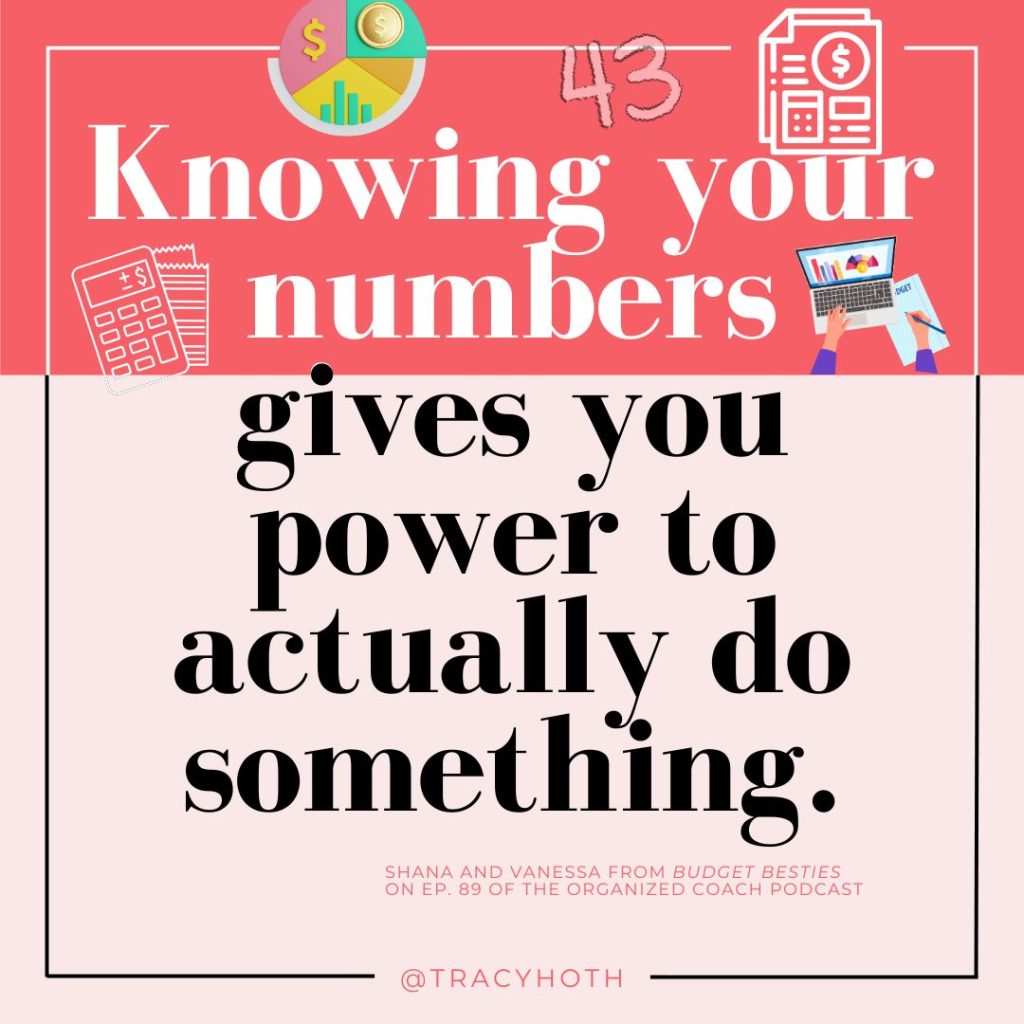
We see that all the time. It’s not as bad. It just, like I said, it just gives you freedom. Like really knowing your numbers gives you power to actually do something. And, and you know, we typically, like we said, we work with people who make good money, but So it’s not, it’s usually not a matter that you’re actually broke.
It’s just, we’ve got to get you organized and intentional. And then, you know, one of our favorite things to do is when we have a coaching session is we update your asset tracker and you know, we’re teaching you to open as many savings buckets as you want. So, okay, well, what’s in your, what’s in your vacation account?
What’s in your kid’s wedding account? What’s in your. Education account. What’s in the Christmas account? And it’s like always going up and I’m like, wait a minute. This is, are you not excited? And they’re like, yeah, we’re so excited. And, and so it’s just, it can be a fun thing. It can be empowering. You just got to take a minute and take ownership.
[00:29:08] Vanessa: I mean, when we look at our clients, so we have, along with an asset tracker, we have a debt tracker and so we fill it in and it automatically updates how much debt they’ve paid off. And so most of our clients are either paying or saving about 20, 000 in six months. And so when we go through that and we’re like, Hey.
You have, you know, I have one client, she’s got over 100, 000 right now between all of her savings accounts, all of her savings buckets. And she said, I have never in my life seen this much money ever. And they always had the capacity to have that much money, but they were never organized enough to just see it all there and have it because they were always racking up a credit card and paying it off, racking up a credit card and paying off and thinking that credit card points was, you know, a thing for them.
Now they’re making more money in interest in the bank than they were in credit card points. They don’t need that. And so, but just for her to know that. My husband can walk away from his job at any moment and we’ll be totally fine. Like that for her, the freedom, the power in that is, is, it’s all worth it.
[00:30:06] Tracy Hoth: Yeah. That is so fun to see those and help people see that and help them reach their goals. Yeah.
[00:30:13] Shana: Yeah.
[00:30:13] Tracy Hoth: Do you, okay, one other question I was just thinking. Do you, do people have like a weekly budget meeting? Do you suggest they, what, what do you recommend with when it comes to that or monthly?
[00:30:26] Shana: Yeah, so you definitely, you know, want to have a monthly budget meeting.
You’ve got to set up your, your, the month, like, so you want to, at the end of the month, you want to look at what’s going to happen next month and, you know, luckily your budgets usually once you have a budget though, it’s going to be pretty consistent month to month. So you’re just looking at it and say, what’s the tweaks that we need to make this month, right?
That’s a little different and that doesn’t take very long. And then, and then really, when you open your phone and you look at your, your accounts, that’s all you have to do to keep up, keep up to date and make sure your budget’s working. And it is, because it’s all automatic. So you don’t have to be, you know, we, we have people that are so used to stressing and worrying and being in it and looking at the numbers and, and, and all of that.
We’re like, you’re going to have to take a break. You’re going to have to find something else to do with your time because you don’t have to do that once you set up our system.
[00:31:08] Vanessa: I had a lady recently, we were in a session, she’s like, well, I, I moved over 73 cents. I know you told me not to, but I did it anyways.
She’s always so anxious. She was always just in her bank accounts, feeling like she had to transfer every little bit and track everything. If it wasn’t perfect, she had to fix it. And so we’re just completely removing and freeing her from that time that she’s spending glued to her phone, staring at her bank app.
But really, you know, at the very beginning, we tell people, give it five minutes a week. Like if you want to, if you’re still unsure or unsettled about it, check in five minutes a week. But once a month, okay, you’re going to sit down and have a budget session and plan for the upcoming month because you really need.
To know what’s happening in the upcoming month. And it’s called adulting. We all love it very much, but it’s really about planning your money ahead of time. And yes, there’s going to be things that pop up. We always add like a miscellaneous or a buffer line because there will be things, especially if you have kids, if you, if you’re not used to having a line item that says kids make one now put money on there, Or put money in there so that way they, you’re always a lot for them.
But you know, at the very beginning, allow yourself the grace to just start figuring it out. And then from there, like Shaina said, you’re going to get bored with this part of your life because it’s going to be systemized, it’s going to be automated, it’s going to be organized, and you don’t have to spend any time on it because it’s all done for you and you can move on to stress about something else.
[00:32:29] Shana: Yeah. Like, like what we’re doing, which is we have children who have birthdays in December, which is not smart. We don’t advise that. Do not. I can just stress about
[00:32:37] Tracy Hoth: that instead, . That’s so fun. Okay. I know there’s people out there that are like, oh my gosh, I need these two girls that are so fun and I need this automation and pretty budget.
How do people reach out? How do they work with you?
[00:32:54] Shana: Well, we have, we have a couple ways. First of all, we’re having a bootcamp and we wanna invite your audience to come to hang out with us. It’s going to be December 30th through January 3rd. What? That’s a weird time to do things, Shane and Vanessa.
You’re right. It is. But you know what we know as soon as the Christmas day is over, you’re like, okay, it’s probably time to look at what I just, what did I just do? At that time you’re probably goal setting and, you know, a lot of trying to get your systems going and everything.
Your mind’s already sort of in January. You’re just not there yet. That’s why we’re doing it that week. At bootcamp, we’re going to. We’re going to go through a different topic every day. We invite you to come to that, which is budgetbesties.com/bootcamp. We’re going to have prizes, giveaways.
It’s going to be fun. And then also, you know, maybe just come listen to our podcast.
[00:33:37] Vanessa: Come find our podcast. It is Financial Coaching for Women. We would love to have you there. And you know what? Our website is budgetbesties.com. And then of course, we always tell people like, gosh, if you have any questions, email us. We talk about that on our podcast all the time.
Hello@budgetbesties.com. Like people get into this and they just were like, I don’t even know where to start. Just ask and we will help you through this.
[00:33:57] Tracy Hoth: I love it. Thank you both, Vanessa and Shaina, so much for being here and sharing. And I just, all I can do is think about a pretty spreadsheet. It’s, and I’m like, okay, I’m excited about it.
So good. Everybody go get in their bootcamp and we will continue to see you on the top of the charts.
[00:34:16] Shana: Yes.
[00:34:17] Tracy Hoth: With you. Okay. Yeah, yeah, yeah. I think we’re in the same category, so it’s kind of fun to see. It is fun to see you up there. It is fun.
[00:34:23] Shana: We’re doing, we’re doing similar, similar life changes. Hopefully, hopefully.
Yeah. Yes, ma’am. Thanks. Thank you for having us.
[00:34:33] Tracy Hoth: Wait, if you’re finding this podcast useful, you must check out the Organized Coach Academy. It’s my course where I walk you through every step to get your business organized, to get yourself organized, to stay organized. Save money and time to prepare to hire someone to do all the things that you want to do in your business with ease.
Check that out at simplysquaredaway.com/OCA. Also, I’m sure you’ve heard this a million times, drop by and get to know me on Instagram at @TracyHoth and until next week, have a beautiful day.